Watch Dr Keith Bush’s talk on prolotherapy
Watch Dr Keith Bush’s full presentation from the Oryon Academy Spinal Symposium, exploring prolotherapy and regenerative soft tissue injections in the management of recurrent spinal pain.
Drawing on more than four decades of clinical experience, Dr Bush discusses spinal instability, patient selection, the anatomical structures targeted during prolotherapy and the evidence behind the treatment.
Prolotherapy is a regenerative injection technique that has been used for decades in the management of musculoskeletal pain. At the Oryon Academy Spinal Symposium, Consultant Orthopaedic & Sports Physician Dr Keith Bush explored the history, evidence and potential applications of prolotherapy, with a particular focus on recurrent spinal pain and instability.
For practitioners managing patients whose back pain repeatedly returns – particularly when symptoms increase with activity – identifying the structures contributing to pain and instability can be challenging.
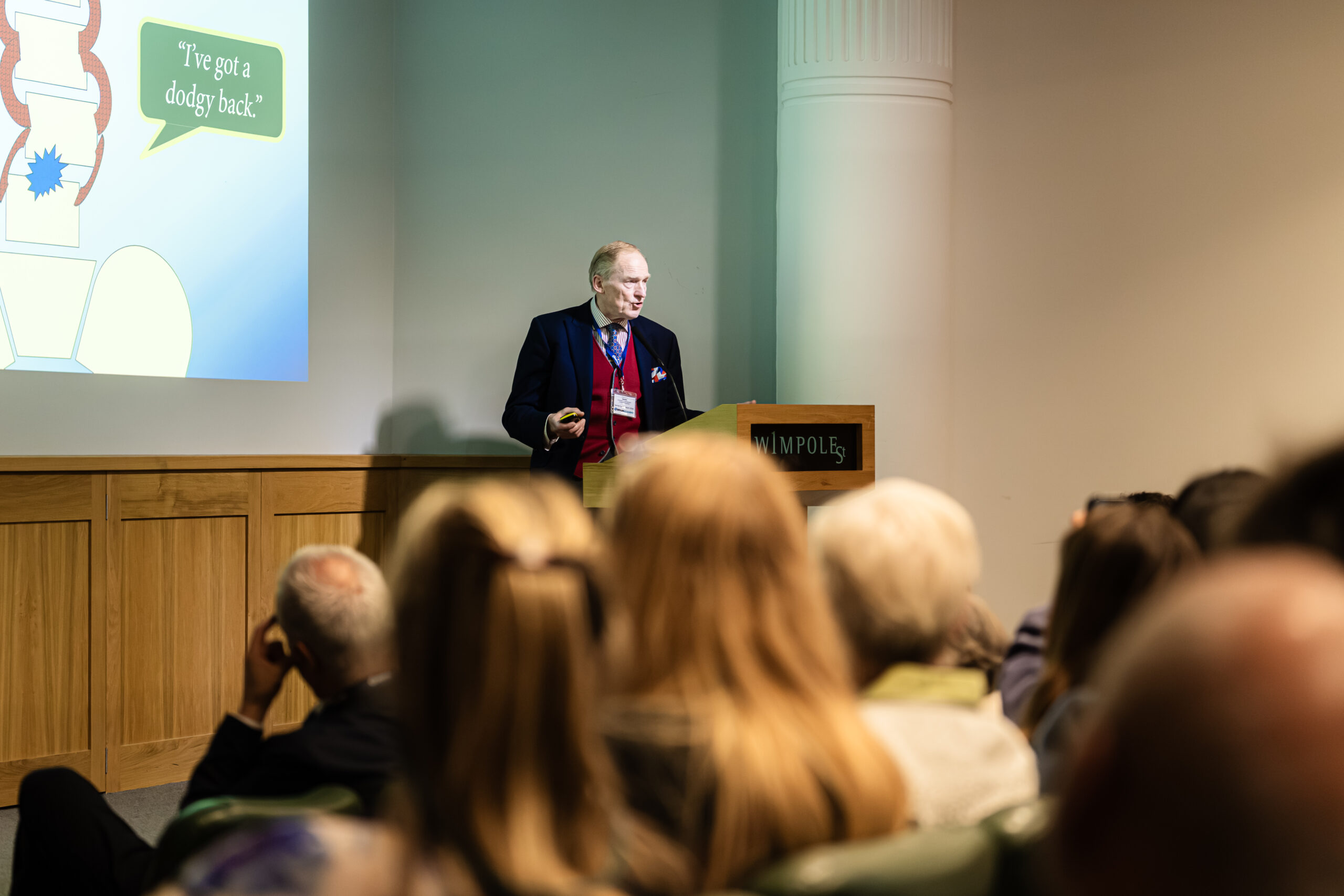
In his presentation at the Oryon Academy Spinal Symposium, Dr Keith Bush discussed how prolotherapy may form part of the management of selected patients with recurrent spinal pain, drawing on more than four decades of clinical experience in orthopaedic and sports medicine.
What is prolotherapy?
Prolotherapy involves injecting a proliferant solution into targeted soft-tissue structures, particularly ligaments and joint-related structures.
The treatment has a long history. Dr Bush traced its development from early sclerotherapy techniques in the 19th century through to work by George Hackett in the 1950s investigating ligament proliferation and joint stabilisation.
Dextrose-based prolotherapy has subsequently been investigated in a range of musculoskeletal conditions, including chronic low back pain and sacroiliac joint pain. Research discussed during the presentation included randomised trials and systematic reviews examining prolotherapy for chronic musculoskeletal pain.
The role of spinal instability in recurrent back pain
One of the central themes of Dr Bush’s presentation was spinal or motion-segment instability.
Some patients describe a pattern of pain that repeatedly settles before returning, often following increased physical activity. Common descriptions can include a back that “keeps going” or recurrent episodes triggered by exercise or loading.
During the symposium, Dr Bush highlighted several clinical scenarios in which instability may be relevant, including:
He identified recurrent spinal pain and pain that increases with increased activity as important features within the clinical presentation discussed.
Which structures can be targeted with prolotherapy?
Prolotherapy is not simply an injection into the area where a patient reports pain. Treatment is directed towards specific anatomical structures identified through clinical assessment.
In the spine, Dr Bush discussed treatment involving structures including the:
Lumbar spine
Sacroiliac joints
Thoracic spine
Cervical spine
The anatomical diagram used during the presentation particularly illustrated the relationship between the lumbar facet capsule, supra/interspinous ligaments, iliolumbar ligament and the dorsal and short interosseous sacroiliac ligaments.
Prolotherapy and sports-related spinal pain
Recurrent pain and instability can be particularly relevant in active patients, where repeated loading places substantial demands on the spine and supporting soft tissues.
Dr Bush highlighted experience across sports including rowing, rugby, football, squash, waterskiing and athletics.
For these patients, the clinical question may therefore extend beyond identifying the site of pain to understanding why symptoms repeatedly return when activity increases.
What does the evidence say about prolotherapy?
Prolotherapy has been used since the mid-20th century, and a body of research has examined its application in chronic musculoskeletal pain.
Studies referenced by Dr Bush included research into dextrose-based and other prolotherapy injections for chronic low back pain and the sacroiliac joint, alongside systematic reviews of prolotherapy for chronic musculoskeletal conditions.
He also highlighted experimental work examining changes within ligament tissue following treatment.
As with any intervention, prolotherapy should be considered in the context of the individual patient’s presentation, diagnosis and wider management rather than as a treatment for back pain generally.
Is prolotherapy safe?
Safety and appropriate patient selection are important considerations with any injection-based treatment.
Dr Bush referenced a 2006 survey of 171 practitioners covering approximately 342,000 prolotherapy treatments over a ten-year period. The study reported adverse effects or reactions requiring hospitalisation at approximately 1 in 5,000 treatments.
The presentation also emphasised the importance of clinical assessment and accurate targeting of the relevant anatomy.
The importance of diagnosis in recurrent spinal pain
Not every patient with persistent or recurrent back pain will be suitable for prolotherapy.
A thorough clinical assessment remains essential to establish the likely source of symptoms and determine the appropriate management pathway.
Imaging can also play an important role where clinically indicated, helping practitioners investigate structural pathology and better understand the patient’s presentation before determining the next stage of treatment.
For patients with recurrent symptoms, the key question is therefore not simply how to relieve an episode of pain, but what may be contributing to its recurrence.
Watch Dr Keith Bush’s talk on prolotherapy
Watch Dr Keith Bush’s full presentation from the Oryon Academy Spinal Symposium, exploring prolotherapy and regenerative soft tissue injections in the management of recurrent spinal pain.
Find a practitioner
If your patient requires further assessment or specialist management following diagnostic imaging, Oryon’s Practitioner Finder can help them find an appropriate healthcare professional.